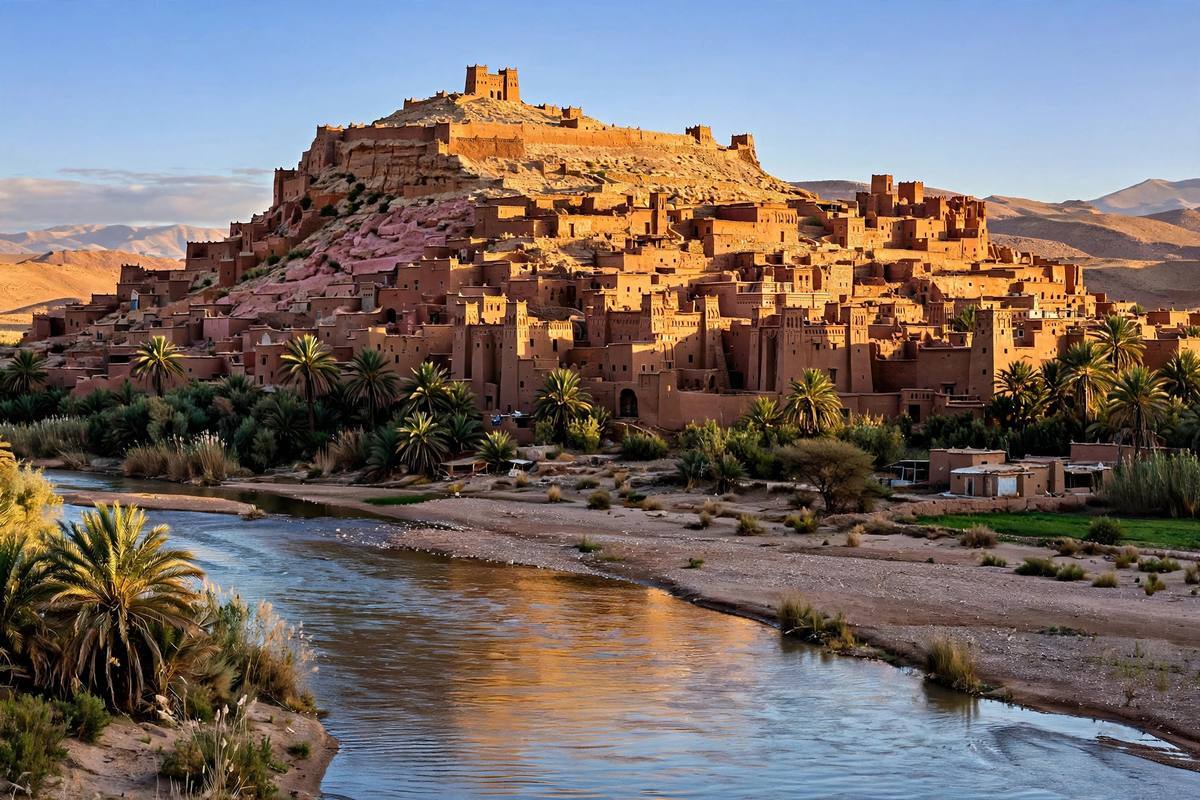
From a distance, Ait Ben Haddou looks less like a village and more like a sandcastle a giant left in the desert. Up close it is even better: a maze of red-clay lanes, carved wooden doors, and towers decorated with geometric brickwork, all stacked up a hillside above the Ounila River. This is Morocco's most famous ksar — a fortified village built from earth, straw, and water nearly a thousand years ago — and one of the country's essential day trips, roughly four to five hours south of Marrakech on the road toward the Sahara.
A brief history of the ksar
Ait Ben Haddou was founded in the 11th century, during the Almoravid period, at a strategic point on the trans-Saharan trade route linking Marrakech to Timbuktu. Caravans of camels passed through carrying gold, salt, and ivory, and the ksar grew rich taxing and sheltering them. The wealthy families built the tallest, most decorated houses you see today — the earthen architecture was both a fortress and a status symbol.
The settlement is a textbook example of southern Moroccan earthen architecture: walls of rammed earth and adobe reinforced with straw, timber beams protruding to carry the upper floors, and towers finished with the triangular and diamond motifs that mark the region's style. UNESCO listed it as a World Heritage site in 1987, and careful restoration has kept the red clay glowing even as most families moved to the modern village across the river. A handful of residents still live inside the old walls, and their shops and small galleries line the main lane up the hill.
Getting there
Ait Ben Haddou sits about 30 kilometres northwest of Ouarzazate, on the far side of the High Atlas from Marrakech. There are three realistic ways to arrive:
- By day tour from Marrakech: the classic option. Shared tours leave around 7–8am, cross the Tizi n'Tichka pass (2,260m), and reach the ksar around midday, returning by 8–9pm. Expect 350–600 MAD per person including the driver and stops.
- By rental car: the most flexible. The drive is 4–5 hours each way with the mountain pass, so consider pairing it with an overnight in Ouarzazate.
- As part of a Sahara route: most 3-day Marrakech-to-Merzouga desert tours stop at Ait Ben Haddou on the way, which spreads the long driving across the whole trip.
What to see and do
The main approach is through the usually shallow Ounila riverbed — which is half the experience. Roll up your trousers or wear sandals, and keep an eye out for the donkeys ferrying goods across. A modern footbridge exists further upstream, but the wade is the classic arrival.
- Climb to the agadir: the fortified granary crowning the hilltop is the highest point, with views over the river, the palm groves, and the whole red village below. The lanes up are steep but short — 20 to 30 minutes at a relaxed pace.
- Spot the film locations: the ksar has starred in Lawrence of Arabia, Gladiator, The Mummy, Kingdom of Heaven, and as Yunkai in Game of Thrones. Local guides love pointing out exactly where the cameras stood.
- Visit the art and carpet cooperatives: several houses inside the ksar double as small galleries and carpet shops — worth a look even if you don't buy.
- Sunset from the far bank: the ksar glows orange in the last hour of light. Photographers gather on the new village side of the river; arrive 60–90 minutes before sunset.
Guides gather at the river crossing and offer tours of the ksar for around 100–200 MAD — agree the price and duration before you start. If you go alone, that's fine too: the lanes are short and the hilltop is always visible, so you can't really get lost.
Practical tips
- Wear grippy shoes: the riverbed is uneven and the clay lanes get slippery after rain.
- Bring cash in dirhams: there are no ATMs inside the ksar, and the small entry contribution plus river-crossing donkey rides are cash only.
- Go early or late: midday tour buses crowd the main lane from 11am to 3pm. Arrive before 10am or after 4pm for the quiet version.
- Stay the night if you can: the new village across the river has comfortable riads and kasbah hotels with rooftop terraces facing the ksar — and sunrise over the walls is worth the extra day.
- Respect the residents: the ksar is still a living village. Ask before photographing people, and keep voices down in the residential lanes.
Plan your Morocco trip
Turn this guide into a booked trip: compare stays, flights and car rental across Morocco below.
Some links on this page are affiliate links. If you book through them, we may earn a commission at no extra cost to you — it keeps these guides free.
Frequently asked questions
How far is Ait Ben Haddou from Marrakech?
About 190 kilometres, or 4–5 hours by road each way via the Tizi n'Tichka mountain pass. Most day tours spend around two hours at the ksar itself, which makes for a long but very doable day.
Can you do Ait Ben Haddou as a day trip from Marrakech?
Yes — it is one of the most popular day trips from Marrakech. Tours leave around 7–8am and return by 8–9pm. If the drive feels long, pair it with Ouarzazate or the start of a Sahara desert trip instead.
Which movies were filmed at Ait Ben Haddou?
Lawrence of Arabia, Gladiator, The Mummy, Kingdom of Heaven, Prince of Persia, and Game of Thrones, where it played the city of Yunkai. The Atlas film studios in nearby Ouarzazate are why so many productions choose it.
Is there an entry fee for Ait Ben Haddou?
The ksar itself asks a small entry contribution, usually a few dirhams, collected by the local association. Local guides are optional and typically charge around 100–200 MAD for a tour of the village.
What is the best time of day to visit Ait Ben Haddou?
Early morning or late afternoon. The red clay glows at golden hour, the midday heat and tour-bus crowds are gone, and sunset from across the river is the site's signature photograph.