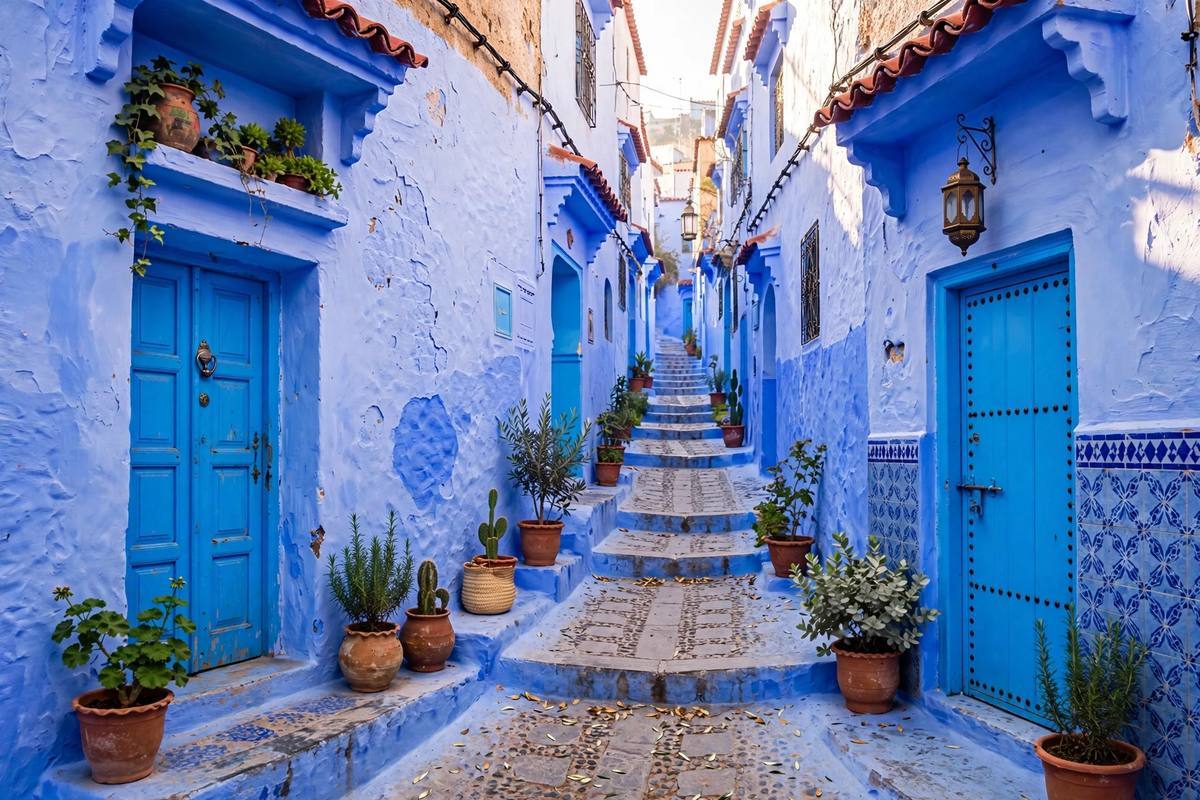
Chefchaouen is Morocco's most photographed town, and it photographs exactly the way the postcards promise: alleyways painted blue, flowerpots spilling over doorways, cats asleep on sun-warmed steps. But most visitors treat it as a half-day photo stop, and they miss the point. Give it two days and the blue city turns out to be one of the calmest, easiest places in Morocco — a mountain town in the Rif where you can actually unwind.
This guide covers a relaxed two-day visit: the medina's best corners on day one, a sunset hike to the Spanish Mosque, and a day trip to the Akchour waterfalls on day two — plus where to stay and what it really costs.
Day 1: Getting lost in the blue medina
Chefchaouen's medina is small — a fraction of the size of Fes or Marrakech — which makes it the one Moroccan old town you can genuinely wander without fear of being hopelessly lost. Start at Plaza Uta el-Hammam, the main square, with its cafes, the ochre-red Kasbah museum and the distinctive octagonal minaret of the Grand Mosque. Entrance to the Kasbah and its gardens costs about 60 MAD (~$6), and the small ethnographic museum inside is worth half an hour.
From the plaza, pick any staircase going downhill. The prettiest streets cluster in the blue quarter near Calle Joulah and the ras el-ma spring, where water still flows and laundry is washed at the stone basins. A few streets to remember:
- Spanish Street / Calle de la Fuente: the classic blue alley with stepped doorways.
- Plaza el-Majzen: a quiet square with a fountain, good for mint tea away from the main plaza.
- The Grand Mosque's octagonal minaret: unlike any other minaret in Morocco — a legacy of the town's Andalusian founders.
Chefchaouen's founders painted the walls blue in the 1930s; locals say it keeps the streets cool and mosquitoes away, and later waves of blue wash became the town's signature. Go out before 9am and the lanes are nearly empty — the best light and the best photos.
Sunset at the Spanish Mosque
An hour before sunset, walk up the hill east of town to the Spanish Mosque (Mezquita Española). It takes 25–30 minutes on a well-worn path from the Bab el-Ansar gate. From the white hillside mosque, the whole blue town spreads below you with the Rif mountains behind — the single best view in Chefchaouen. Bring water, a light layer (it cools fast after sunset), and walk back while there is still light.
Day 2: The Akchour waterfalls
On day two, join the locals' favourite escape: Akchour, a gorge of waterfalls and natural pools about 30 km from Chefchaouen (grand taxi or organized tour from town, roughly 30–50 MAD per seat in a shared taxi each way). The main trail leads past olive groves to the Grand Cascade, a 100-metre waterfall with a swimming pool at its base. The full walk is 2–3 hours round trip, easy to moderate, and refreshingly cool even in summer.
If you prefer to stay in town, day two is also perfect for a stroll through the weavers' quarter, where the striped Chefchaouen blankets you will see everywhere are woven and sold, a slow morning in the Kasbah gardens, or a short drive to the nearby village of God's Bridge (Pont de Dieu) — a natural stone arch over the Oued Farda river.
Where to stay: riads in the medina
Stay inside the medina if you can — mornings and evenings in the blue lanes are the best part of the trip. Budget guesthouses start around 250–400 MAD ($25–$40) a night; comfortable mid-range riads with breakfast run 500–900 MAD ($50–$90); the fancier options with rooftop terraces push 1,200 MAD ($120) and up. Book a room with a terrace if you can — breakfast above the blue rooftops is the memory you will keep.
Chefchaouen is cheaper than Marrakech but not dirt cheap. Budget roughly 400–700 MAD ($40–$70) per person per day for a comfortable trip: a mid-range riad, restaurant meals, taxis and entrance fees.
Practical tips
- Getting there: direct CTM buses from Fes (4 hours) and Casablanca/Rabat (via Fes). There is no train to Chefchaouen — the nearest station is Fes.
- ATMs: plenty around Plaza Uta el-Hammam, but carry some cash — small guesthouses and taxis are cash-only.
- What to wear: the Rif is conservative; dress modestly out of respect, especially around mosques.
- Hassle: very little by Moroccan standards, though you may meet persistent guides near the plaza. A polite no is enough.
Plan your Morocco trip
Turn this guide into a booked trip: compare stays, flights and car rental across Morocco below.
Some links on this page are affiliate links. If you book through them, we may earn a commission at no extra cost to you — it keeps these guides free.
Frequently asked questions
Why is Chefchaouen painted blue?
The town's residents began painting the medina blue in the 1930s. Locals give several reasons — the blue keeps homes cool, repels mosquitoes, echoes the sky — and later generations kept the tradition because it became the town's identity and a draw for visitors.
How many days do you need in Chefchaouen?
Two full days is the sweet spot. One day covers the medina, the Kasbah and the Spanish Mosque at sunset; the second day is for the Akchour waterfalls or a slow morning in the blue lanes. One day feels rushed; three is plenty unless you want to hike the Rif.
How do I get to Chefchaouen from Fes?
Direct CTM buses run from Fes to Chefchaouen in about 4 hours (around 80–100 MAD). There is no train station in Chefchaouen, so the bus or a private transfer is the standard option. Grand taxis also run between Chefchaouen and nearby towns like Tetouan.
Is Chefchaouen safe for tourists?
Yes — Chefchaouen is one of Morocco's calmest towns for visitors. It is small, walkable, and far less hectic than Marrakech or Fes. Normal precautions apply: keep valuables out of sight in the souk and avoid unlit lanes late at night.
Where should I stay in Chefchaouen?
Stay inside the medina for the full blue-city experience — budget guesthouses from ~250 MAD a night, mid-range riads with breakfast from 500–900 MAD, and rooftop-terrace options from around 1,200 MAD. Rooftop breakfasts above the blue rooftops are worth paying extra for.