Stargazing in the Sahara Desert Morocco delivers one of the most spectacular night skies on the planet. Hundreds of kilometres from the nearest real city lights, the darkness is so complete that the Milky Way casts a faint shadow across the sand — and on a moonless night, the sky burns with thousands of stars most travellers have never seen. This guide covers where to go for the best Sahara stargazing, when the night sky is at its clearest, what you'll actually see overhead, and how to plan your night under the stars — including the desert camps near Merzouga that make the whole experience effortless.
Why the Sahara Has One of the Darkest Skies on Earth
The Moroccan Sahara sits under a Bortle Class 1 sky — the darkest rating on the light-pollution scale, shared with the most remote deserts on Earth. There is no industry, no streetlight glow, no lit highways for hundreds of kilometres. Add bone-dry desert air with almost no humidity, and stars that would be invisible anywhere else burn straight through. From the big dunes around Merzouga, the horizon glow of the tiny village is blocked entirely, so the darkness wraps around you in every direction. Photographers and astronomers call this a true dark-sky site — and Morocco is one of the few places in the world where you can reach one on a weekend trip.
The Sahara night sky is also huge. The dunes are low on the horizon, the air is still, and nothing interrupts your view from one edge of the sky to the other. First-time stargazers often say the same thing: they didn't know the sky could look like this.
Stargazing in the Sahara Desert Morocco: Where to Go
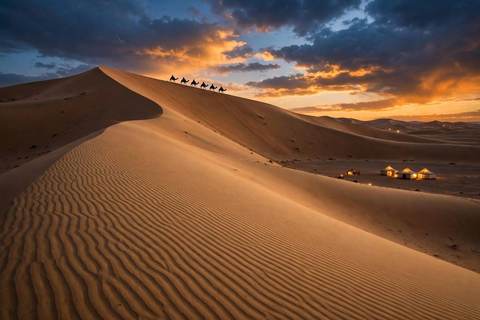
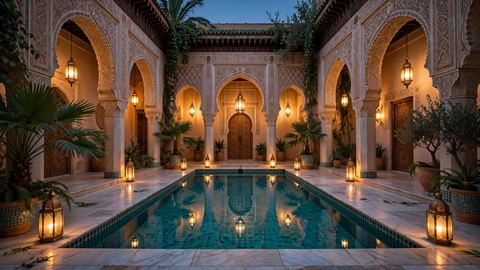
For the best Sahara stargazing, head to the Erg Chebbi dunes near Merzouga, in Morocco's southeast. These 150-metre dunes rise far from towns, and most desert camps are pitched deep among them — a camel ride from the village. Camps further from Merzouga's lights offer the darkest skies, so it pays to ask where exactly a camp is located before booking. Luxury desert camps with real beds and private tents are scattered through the same dunes, and they make an excellent base for a night of stargazing — many set out rugs and tea after dinner precisely so guests can lie back and watch the sky.
Zagora and the Agafay desert also offer good stars, but neither matches Erg Chebbi's combination of altitude, darkness and distance from settlements. If stargazing is the main event, Merzouga is the answer.
Check the moon phase before you book. A full moon is bright enough to wash out the Milky Way and most faint stars. The best nights for Sahara stargazing are the three or four days around the new moon, when the sky is at its darkest. Many travellers plan their desert trip around the lunar calendar — it's the single biggest upgrade you can make to the experience.
When to Go: The Best Time for Sahara Stargazing
The best time for Sahara stargazing is October to May, when nights are long and the desert air is at its clearest. Winter (December to February) offers the crispest skies of all — but also the coldest nights, when temperatures can drop close to freezing. Spring and autumn strike the best balance: dark skies until late in the evening, and nights that are cool rather than brutal. Summer brings the Milky Way's bright galactic core into view, but August heat, dust haze and shorter nights make it the least comfortable season for a night outside.
What You'll See in the Sahara Night Sky
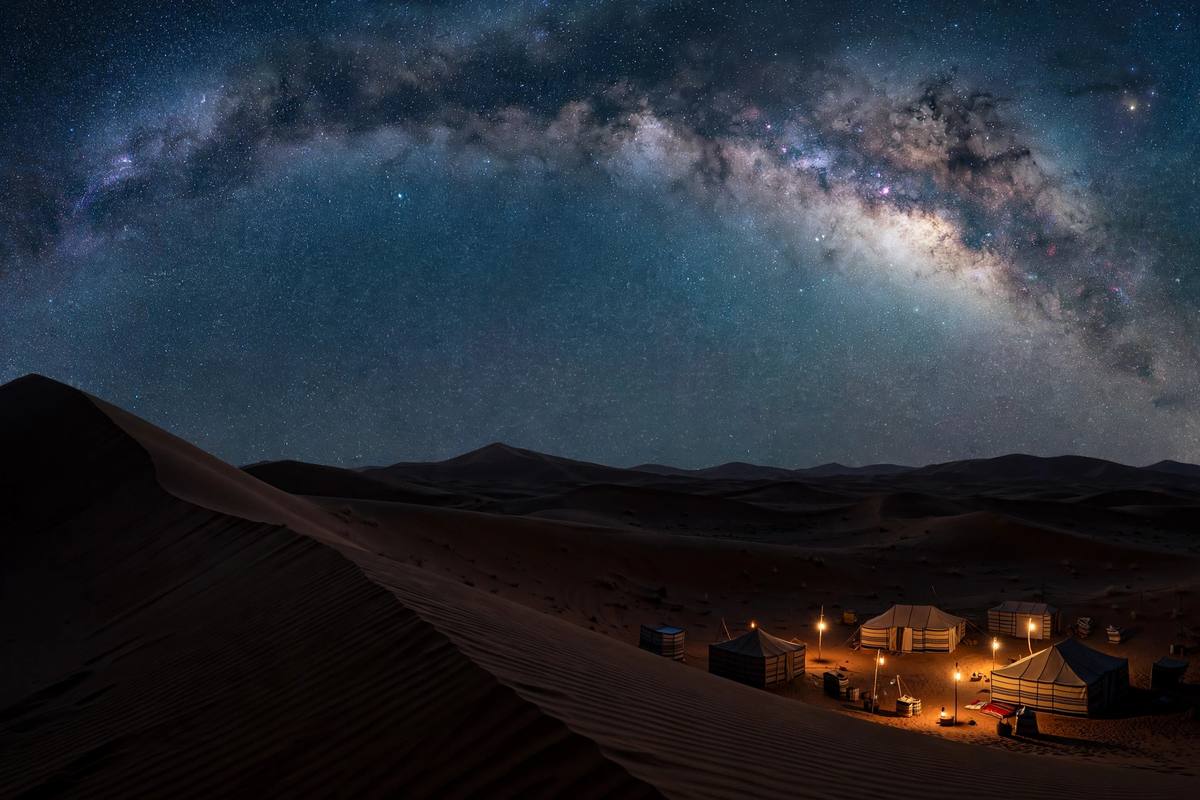
On a moonless night, the Milky Way stretches overhead as a glowing band of light — our galaxy seen from the inside, visible in Morocco's desert skies with startling clarity. Saturn and Jupiter often hang bright and steady, and on a good night you can watch satellites glide silently across the constellations. In winter, Orion dominates the sky; in summer, Scorpius and the teapot of Sagittarius point the way to the galaxy's heart.
Meteor showers are a bonus if you time your trip right: the Perseids peak in mid-August, the Geminids in mid-December. And in the hour before dawn, keep an eye out for the zodiacal light — a faint triangular glow rising from the horizon that only appears in truly dark skies.
- The Milky Way's bright core: best from June to September.
- Orion, Scorpius and Cygnus: easy constellations for beginners.
- Jupiter and Saturn: bright, steady "stars" that don't twinkle.
- Meteors: the Perseids (August) and Geminids (December) reward patient watchers.
- The zodiacal light: a faint glow before dawn in the darkest skies.
Astrophotography is easier than you think. A tripod, a camera with manual mode (or a phone with night mode), and a 20–25 second exposure are enough to capture the Milky Way over the dunes. Keep exposures under 30 seconds to avoid star trails, focus manually on the brightest star, and let your eyes re-adapt to the dark after each screen check.
How to Plan Your Night Under the Stars
Most travellers reach Merzouga on a desert tour from Marrakech or Fez — typically a 2- or 3-day round trip that includes the camel ride, dinner at a desert camp, and a night in a tent among the dunes. If you'd rather travel independently, buses and private drivers run to Merzouga, and camps arrange the camel transfer from the village. Either way, your stargazing needs no extra booking: once the campfire dies down and the generators switch off, the sky does the rest.
Costs are refreshingly modest: a standard desert camp night with dinner and breakfast typically runs from around 60 to 150 euros per person, with luxury camps from about 200 euros. Bring warm layers — the Sahara's day-night temperature swing is legendary — a red flashlight (white light ruins your night vision for twenty minutes), and a warm hat. Most camps provide blankets, but desert nights in winter are genuinely cold, so a sleeping bag liner is a smart extra.
Plan your Morocco trip
Turn this guide into a booked trip: compare stays, flights and car rental across Morocco below.
Some links on this page are affiliate links. If you book through them, we may earn a commission at no extra cost to you — it keeps these guides free.
Frequently asked questions
Where is the best place to go stargazing in the Sahara Desert?
The Erg Chebbi dunes near Merzouga, in southeast Morocco. Camps pitched deep among the dunes sit under a Bortle Class 1 dark sky, far from any town lights — ask how far from the village a camp is before booking, as the most remote camps have the darkest skies.
When is the best time for stargazing in the Sahara?
October to May, when nights are long and the desert air is clearest. Winter has the crispest skies (and coldest nights), while spring and autumn offer the best balance. Plan around the new moon — a full moon washes out the Milky Way and faint stars.
Can you see the Milky Way in Morocco?
Yes — the Moroccan Sahara has some of the darkest skies on Earth, and on a moonless night the Milky Way is clearly visible as a glowing band across the sky. Its bright galactic core shows best from June to September.
Is it cold at night in the Sahara Desert?
Yes — the Sahara's temperature can drop 20°C or more after sunset. Summer nights are warm, but from October to May you'll want warm layers, and in winter (December to February) temperatures can approach freezing. Desert camps provide blankets, but a warm jacket and hat are essential.
Do you need a tour for Sahara stargazing?
You don't need a special stargazing tour — most desert camps near Merzouga are already in dark-sky territory, and the stars are free once the camp lights go down. Most travellers reach the camps on a 2- or 3-day desert tour from Marrakech or Fez, but independent travellers can also get to Merzouga by bus or private driver and join a camp directly.