The good news first: getting into Morocco is easy for most travellers. Citizens of the US, the UK, Canada, Australia and the whole EU walk up to the immigration desk, get a stamp, and walk in — no application, no fee, no waiting for an approval email. Your passport simply gets you 90 days.
But "most" is not "all". This guide covers the e-visa for nationalities that need one, the six-month passport rule airlines enforce, how the 90-day stay works, and what happens if you want longer — updated for 2026.
Who can enter Morocco without a visa
Morocco grants visa-free entry for up to 90 days to citizens of a long list of countries, including:
- The United States, Canada, the United Kingdom and Ireland
- All EU and Schengen countries, plus Norway and Switzerland
- Australia, New Zealand, Japan, South Korea and Singapore
- Brazil, Mexico, Argentina and Chile
- Turkey, the Gulf states (UAE, Saudi Arabia, Qatar, Kuwait, Bahrain, Oman), Israel and China
- Senegal, Ivory Coast, Niger, Mali, Guinea, Congo-Brazzaville and Gabon
If your country is on the list, there is nothing to arrange in advance: you arrive, get the stamp, and the 90-day clock starts. Stamps are usually single-entry — leave Morocco and the count resets on re-entry.
The visa-free stay is 90 days within Morocco — not a rolling 90-in-180 like Schengen. It starts on arrival day and includes departure day; plan longer trips around the extension process below.
Who needs a visa for Morocco
If your nationality is not on the visa-free list, you need a visa before you fly. This includes most travellers from India, Pakistan, Bangladesh, the Philippines, and many countries in sub-Saharan Africa and the Middle East. The full, current list changes occasionally, so check with the nearest Moroccan embassy or consulate — but do it early, because consulate appointments can take weeks.
Key point: there is no visa on arrival for nationalities that require one — airlines will deny you boarding without a visa or e-visa, not just turn you away in Casablanca.
The Morocco e-Visa: who qualifies and how to apply
Morocco runs an official e-visa for citizens of countries that require a visa, applied for online through the government's e-visa portal. It grants a single entry of up to 30 days. Here is how it works:
- Apply online at least a few days before travel — processing is often quoted around 96 hours, but apply earlier in busy seasons
- You will need a passport scan, a recent passport-style photo, and proof of your flight and accommodation bookings
- Pay the visa fee online by card; print the approved e-visa and carry it with your passport
- The e-visa is single-entry: if you plan to leave and re-enter Morocco, arrange that separately
A printed copy matters. Phone screens fail at the worst moments — border officers want paper.
Passport and document requirements
- Six months' validity: Morocco officially asks for a passport valid for the duration of your stay, but airlines routinely enforce a six-month rule at check-in. Don't gamble — renew early if yours is close.
- A blank page: the entry stamp needs somewhere to live. One blank page is the safe minimum.
- Proof of onward travel: rarely asked for, occasionally asked for. A return or onward ticket on your phone ends the conversation.
- Accommodation details: the immigration card asks for your first night's address — have your riad or hotel name ready.
- Travel insurance: not legally required, but Moroccan hospitals charge upfront, so it's the cheapest peace of mind you'll buy.
- Children: every child needs their own passport; if travelling with one parent or a guardian, carry a notarised consent letter from the absent parent.
At the Moroccan border: what actually happens
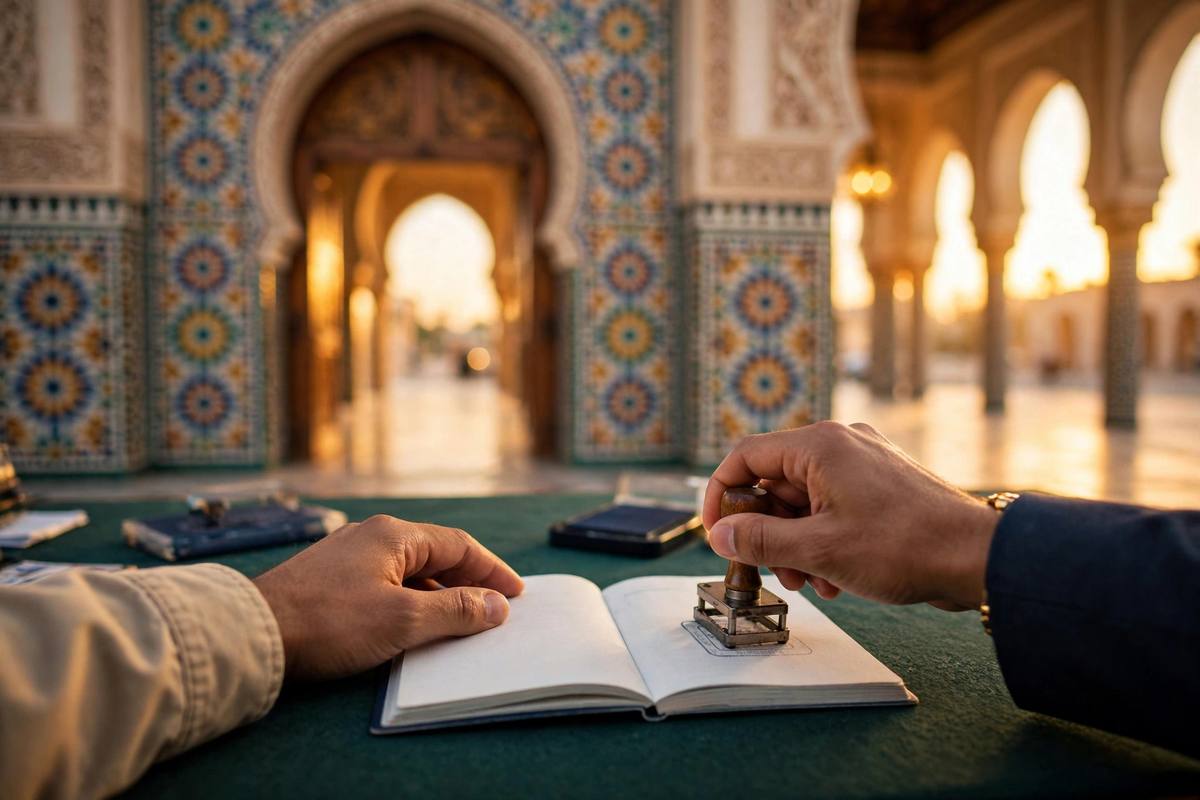
On the plane you'll usually get a small immigration card (fiche) to fill in: name, passport number, flight, first address in Morocco. At the desk, the officer checks your passport, sometimes asks how long you're staying, and stamps you in — the queue is the slow part, not the interview.
Hotels and riads photocopy your passport and stamp at check-in — it's the law. A clear entry stamp makes every check-in smoother, so don't let the page get crumpled.
Extending your stay beyond 90 days
Want more than 90 days? Apply for an extension (prolongation de séjour) at the police prefecture (préfecture de police) of the city you're staying in, before your 90 days run out. Bring your passport, proof of accommodation, proof of funds, and patience — allow a couple of weeks. Extensions are commonly granted for another 90 days.
The old "border run" trick — hopping to Ceuta or Melilla for a day to reset the clock — sits in a grey area, not a right. Overstaying without an extension is worse: expect a fine, a stern interview, and possible trouble on your next visit.
Customs: what you can bring in
- Currency: you may import up to 2,000 dirhams in Moroccan currency; foreign currency has no limit, but amounts over 100,000 dirhams equivalent must be declared.
- Drones: banned without a permit. Flying one without authorisation risks confiscation at the airport.
Morocco's entry rules are refreshingly simple for most visitors: a valid passport, a stamp, ninety days. Handle your nationality's paperwork before you fly, and the best part of your trip — the mint tea part — starts immediately.
Plan your Morocco trip
Turn this guide into a booked trip: compare stays, flights and car rental across Morocco below.
Some links on this page are affiliate links. If you book through them, we may earn a commission at no extra cost to you — it keeps these guides free.
Frequently asked questions
Do US citizens need a visa for Morocco?
No. US passport holders get 90 days visa-free on arrival — just a stamp at immigration. Your passport should be valid for at least six months beyond your travel dates, and keep one blank page for the stamp.
Do UK citizens need a visa for Morocco?
No. British passport holders also get 90 days visa-free, and Brexit didn't change that. The same 90-day limit, extension process and document requirements apply.
How does the Morocco e-visa work?
The e-visa is for nationalities that need a visa. Apply online before you travel with a passport scan, a photo, and proof of flights and accommodation. It grants a single entry of up to 30 days — print the approval and carry it with your passport.
Can I extend my 90 days in Morocco?
Yes. Apply for a stay extension at the police prefecture of your city before the 90 days expire, with your passport, proof of accommodation and proof of funds. Extensions of another 90 days are commonly granted — don't just overstay.
How long must my passport be valid to enter Morocco?
Officially it must cover your whole stay, but airlines commonly enforce a six-month validity rule at check-in. Renew early if your passport expires within six months of your trip — being turned away at boarding is the real risk.