Grand Stade Hassan II is the name every football fan will know by 2030: a 115,000-seat colossus rising from a forest outside Casablanca, designed to become the largest football stadium on the planet — and the centerpiece of Morocco's bid to host the World Cup final.
Whether you are planning a 2030 World Cup trip or simply want to understand the most ambitious stadium project in football history, this guide covers it all: where the stadium stands, how big it really is, when it opens, how you will get there on matchday, and the honest story behind the race for the final.
Grand Stade Hassan II at a glance
- Location: El Mansouria, Benslimane province — about 40 km northeast of central Casablanca
- Capacity: 115,000 seats, planned to be the world's largest football stadium
- Status: Under construction, roughly 40% complete in 2026
- Opening: Targeted for the end of 2027
- Architects: Oualalou + Choi with Populous
- After 2030: Home of Raja CA, Wydad AC and the Morocco national team
Where is Grand Stade Hassan II?
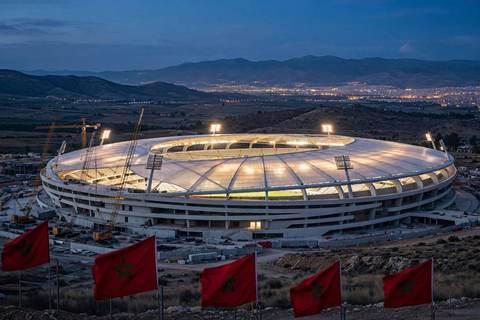
The stadium occupies a 100-hectare site in the commune of El Mansouria, in Benslimane province of the Casablanca-Settat region. It sits roughly 40 kilometres northeast of central Casablanca — not in the city itself, but in a forested area chosen to give the project room to breathe, with space for parking, fan zones and landscaping on a scale no downtown site could offer.
For visitors, the practical reference points are Casablanca (about 40 km by road) and Mohammed V International Airport (roughly an hour's drive, routed via Casablanca). Most fans will base themselves in Casablanca — Morocco's largest city, with the deepest hotel stock — and travel out on matchdays.
How to get to Grand Stade Hassan II
Morocco is building the transport links alongside the stadium. The new Casablanca–Rabat motorway passes right beside the site, and a dedicated high-speed rail station — expected to be called Benslimane Grand Stadium — is planned on the high-speed line, putting the ground about 15 minutes from Casablanca by fast train. More than 10,000 parking spaces are planned for drivers and supporter buses.
Grand Stade Hassan II capacity: 115,000 seats
The headline number is 115,000 — reported consistently across every source. If delivered as planned, that makes Grand Stade Hassan II the largest football-specific stadium in the world, overtaking Pyongyang's Rungrado 1st of May Stadium (114,000).
The bowl is designed as three steep, compact tiers to keep all 115,000 spectators close to the pitch, with five hospitality levels, around 12,000 VIP and VVIP seats and a royal box. Everything is being built to full FIFA compliance, which is no surprise given what the stadium is bidding for.
Construction: the road to the end of 2027
Groundworks began in August 2024, and by 2026 the site was running at full tilt: roughly 5,000 workers on three shifts, with the project estimated at about 40% complete. The main construction contract (worth around $320 million) went to the Moroccan consortium TGCC & SGTM in mid-2026, and the current target is completion by the end of 2027 — giving a comfortable buffer before 2030.
The budget tells its own story. The official figure stands at 5.1 billion dirhams (about $500 million), but an independent audit of awarded and launched contracts in 2026 put the real total at 13.6 billion dirhams (about $1.36 billion) and rising — a reminder of the sheer scale of what is being built. One contract, for the 115,000 seats themselves, had to be re-tendered after both bids were rejected: a small sign that even this project has its headaches.
A stadium shaped like a Moroccan moussem tent
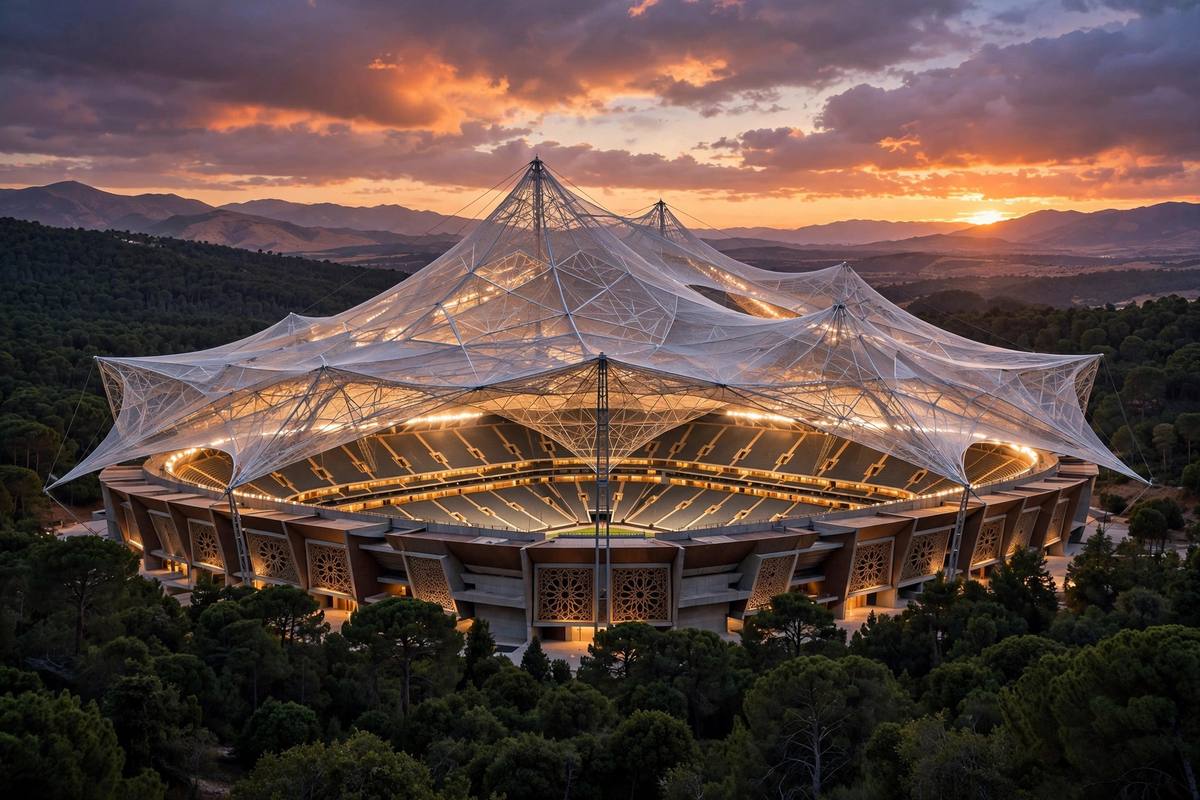
The design, by Paris-based Oualalou + Choi in collaboration with global stadium specialists Populous, beat six rival firms including Herzog & de Meuron, Zaha Hadid Architects and Foster + Partners. Its signature is a vast translucent aluminium-lattice canopy inspired by the traditional Moroccan moussem tent, appearing to rise out of the surrounding forest.
A ring of 32 monumental stairways forms the entrances, and gardens are suspended some 28 metres above the ground, with botanical gardens at ground level — the architects describe it as an oasis of greenery. It is a deliberate statement: a stadium that could only be Moroccan.
Will Grand Stade Hassan II host the 2030 World Cup final?
Here is the honest answer: it has not been decided. FIFA stated in September 2026 that "no final decision" has been taken on the final venue. Morocco is campaigning hard — federation president Fouzi Lekjaa has publicly claimed the final for Benslimane, and Senegal's FA president backed Morocco's bid in October 2026 — but Spain is pushing the Bernabéu and Camp Nou just as hard. It is a genuine three-way race.
What is certain is that Morocco will host a large share of the tournament across six cities and that this stadium, as the largest, is built for the biggest occasion. The opening matches, by the way, go to Uruguay, Argentina and Paraguay as a centenary tribute — so the final is the prize everyone is watching.
After 2030: Raja, Wydad and the national team
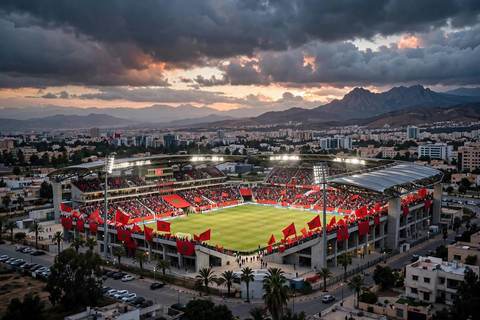
The stadium is not a white elephant in waiting. After the World Cup it becomes the de facto national stadium: home to the Morocco national team and to both Casablanca giants, Raja CA and Wydad AC — which means the fiercest derby in African football gets a 115,000-seat stage. If you cannot make 2030, a Raja–Wydad derby here in the 2030s might be the next best thing.
Planning your 2030 trip: tickets, hotels and matchday
Tickets: as of late 2026 there is no official ticket sale yet. Expect FIFA's usual ballot system closer to the tournament — register interest on FIFA's channels early and beware of unofficial sellers.
Where to stay: Casablanca is the obvious base (40 km away, huge hotel range, airport connections). Rabat is another strong option on the high-speed line. Book early: World Cup host cities always sell out, and 2030 spans three countries.
Matchday: aim for the high-speed rail station when it opens; allow generous time; and remember that Moroccan evenings can be cool even in summer — the final is in July, but night matches in an open bowl still call for a light layer.
Plan your Morocco trip
Turn this guide into a booked trip: compare stays, flights and car rental across Morocco below.
Some links on this page are affiliate links. If you book through them, we may earn a commission at no extra cost to you — it keeps these guides free.
Frequently asked questions
How many seats will Grand Stade Hassan II have?
115,000. That figure is reported consistently across all sources, and if delivered as planned it will make Grand Stade Hassan II the largest football-specific stadium in the world, ahead of Pyongyang's Rungrado 1st of May Stadium (114,000).
When will Grand Stade Hassan II open?
The current target is the end of 2027. Groundworks began in August 2024 and the project was estimated at about 40% complete in 2026, with around 5,000 workers on site.
Will the 2030 World Cup final be played at Grand Stade Hassan II?
It has not been decided. FIFA said in September 2026 that no final decision has been taken. Morocco is bidding hard for the final at Benslimane, but Spain is pushing the Bernabéu and Camp Nou — it is a genuine three-way race.
Where is Grand Stade Hassan II located?
In El Mansouria commune, Benslimane province, about 40 km northeast of central Casablanca, on a 100-hectare forested site. Most visitors will base themselves in Casablanca and travel out on matchdays.
How do I get to Grand Stade Hassan II?
The new Casablanca–Rabat motorway passes beside the site, a dedicated high-speed rail station (Benslimane Grand Stadium) is planned about 15 minutes from Casablanca, and 10,000+ parking spaces are planned. The train is expected to be the smartest matchday option.
Which teams will play at Grand Stade Hassan II after the World Cup?
It becomes Morocco's de facto national stadium: home to the Morocco national team and to both Casablanca clubs, Raja CA and Wydad AC — including the Casablanca derby.