Rabat is the capital travellers least expect. While Marrakech roars and Fes hypnotises, Morocco's political capital moves at a calmer tempo: broad boulevards, shaded parks, a whitewashed kasbah hanging over the Atlantic, and a UNESCO-listed historic core you can walk without a guide. Give it two days and Rabat delivers the most relaxed city break in the country — plus a front-row seat to Moroccan history from the 12th century to independence.
Day 1: the Kasbah, the medina and the ocean front
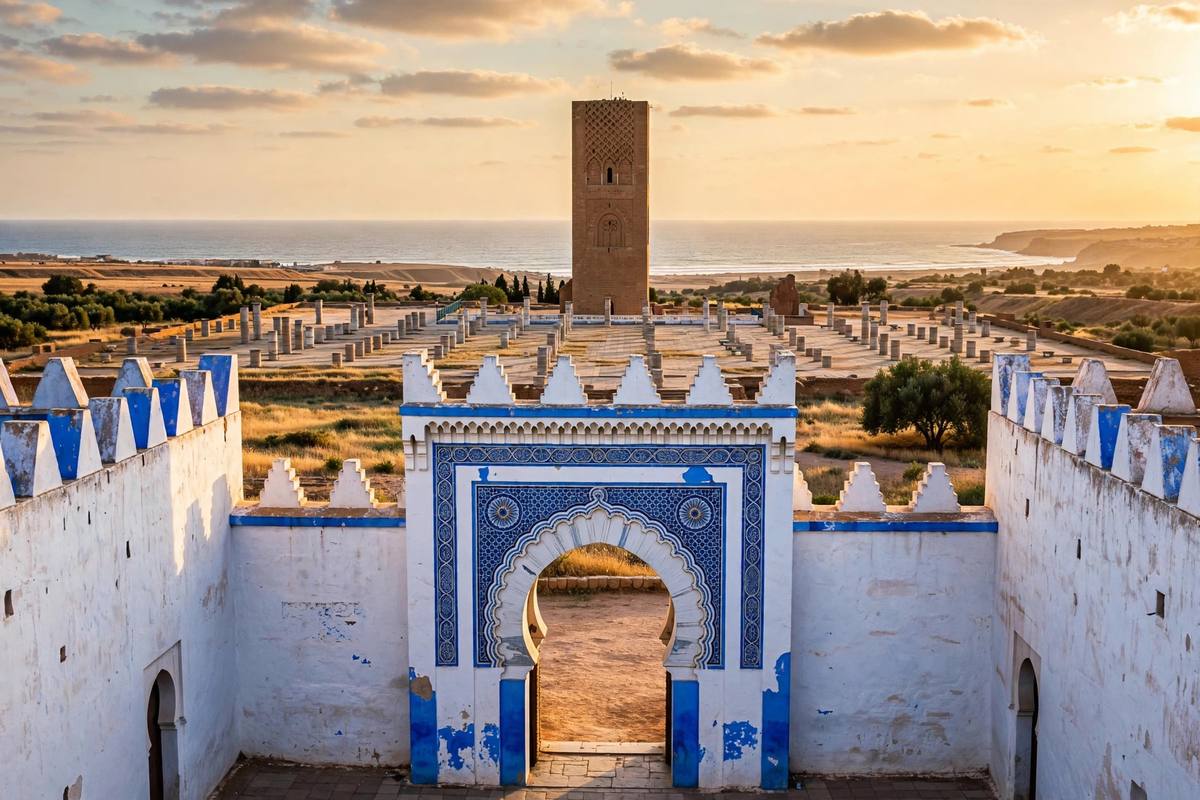
Start at the Kasbah of the Udayas, the blue-and-white fortress that guards the mouth of the Bou Regreg river. Enter through the monumental 12th-century Almohad gate — one of the most beautiful in Morocco — and wander lanes that feel closer to an Andalusian village than an African capital. Climb the old ramparts for the Atlantic view, then slow down in the Andalusian Gardens tucked inside the walls: citrus trees, hibiscus and tiled fountains laid out in the 1910s. The tiny Oudayas Museum, housed in the former palace, holds a quiet collection of Rabati jewellery and musical instruments and is worth twenty minutes.
Walk down into the old medina through the Rue des Consuls. This medina is compact and honest: no one drags you into a carpet shop, and prices for leather babouches, woven baskets and djellabas stay local. Stop at a pastry stall for kaab el ghazal, the crescent almond biscuits Rabat does better than anywhere else in Morocco.
In the afternoon, cross the river on the tram to Salé, Rabat's twin city on the north bank. The old medina of Salé, once a corsair republic, holds the Grand Mosque and a beautifully restored 14th-century medersa that most tour groups never reach. Return to Rabat for sunset on the Corniche below the Kasbah, where fishermen cast lines off the rocks and the light turns the whitewashed walls gold.
Rabat's tram is one of the easiest in Africa: two lines connect the Kasbah, the medina, both main stations and Salé, and a single ticket costs 6 dirhams — buy it from the machines at the stop before boarding.
Day 2: Hassan Tower, history and the green capital
Begin at the Hassan Tower, the unfinished 12th-century minaret of a mosque that was meant to be the largest in the world. It stopped at 44 metres when Sultan Yacoub al-Mansour died in 1199, and the half-built prayer hall's forest of columns still stretches across the esplanade. Storks nest on the tower's ledges in spring, and the symmetry with the white-marble Mausoleum of Mohammed V across the square makes this Rabat's most photographed spot. The mausoleum — where the king who led Morocco to independence rests alongside his sons under a green-tiled pyramidal roof — is guarded by the Royal Guard in ceremonial dress, and the interior of carved cedar and onyx is genuinely moving.
Next, head to the Rabat Archaeological Museum on Rue de Brihi, home to Morocco's finest Roman bronzes recovered from Volubilis, or to Chellah, the walled necropolis south of the medina where a Roman city, a medieval Merinid sanctuary and resident storks share one atmospheric site. Entrance is 70 dirhams and an hour here is enough.
Spend the afternoon on the green side of the city: the Jardin d'Essais, the city's botanical gardens, and the vast, palm-lined Avenue Mohammed V, which leads from the central station to the modernist parliament quarter. Rabat earned its UNESCO listing as a "modern capital and historic city" precisely for this blend of heritage and 20th-century planning.
Chellah closes at sunset and the light in the last hour is the best of the day — go around 4 pm and finish on the ramparts overlooking the Bou Regreg estuary.
Where to stay in Rabat
- The Kasbah and medina — small riads and guesthouses inside the old walls, steps from the gardens and the Corniche; the prettiest but priciest corner of the city.
- Hassan district — mid-range hotels around the central station and Avenue Mohammed V, walkable to the medina and the tower.
- Agdal and Souissi — business hotels and serviced apartments with easy tram and taxi access; the best value if you are arriving by high-speed train at Rabat-Agdal.
Getting to Rabat
Rabat has its own international airport (RBA) with European and domestic flights, but most visitors arrive by train — and Rabat is the best-connected rail city in Morocco. The Al Boraq high-speed line reaches Casablanca in about 50 minutes and Tangier in 1 hour 20 from Rabat-Agdal; ONCF trains from Marrakech take around 4 hours. Rabat-Ville station sits between the medina and the Hassan Tower, so arriving by train drops you exactly where the sightseeing begins. From Casablanca's Mohammed V airport, take the shuttle train to Casa-Voyageurs or Casa-Oasis and change for Rabat — the whole journey is about 1 hour 45.
Plan your Morocco trip
Turn this guide into a booked trip: compare stays, flights and car rental across Morocco below.
Some links on this page are affiliate links. If you book through them, we may earn a commission at no extra cost to you — it keeps these guides free.
Frequently asked questions
Is Rabat worth visiting?
Yes — Rabat is Morocco's calmest and greenest capital, with a 12th-century kasbah, the Hassan Tower, shaded boulevards and the Atlantic, all in a walkable centre. It is the ideal slow start or finish to a Morocco itinerary, and a comfortable base for 2030 World Cup travel.
How many days do you need in Rabat?
Two full days cover the essentials: the Kasbah of the Udayas and Andalusian Gardens, the old medina, the Hassan Tower and the Mausoleum of Mohammed V, plus a half day in Salé or at Chellah. Add a third day for the beaches at Temara or a day trip to the Roman ruins of Volubilis.
What is the Kasbah of the Udayas?
The Kasbah of the Udayas is a 12th-century Almohad fortress at the mouth of the Bou Regreg river in Rabat, entered through a monumental carved gate. Its whitewashed, blue-trimmed lanes, ocean-view ramparts and Andalusian Gardens make it one of Morocco's most photographed sites and part of Rabat's UNESCO World Heritage listing.
How do I get from Casablanca airport to Rabat?
Take the shuttle train from Mohammed V airport to Casablanca (Casa-Voyageurs or Casa-Oasis), then change to a direct train or the Al Boraq high-speed service to Rabat — the whole trip takes about 1 hour 45 minutes. Rabat-Ville station is a short walk from the medina and the Hassan Tower.
Is Rabat walkable?
Yes. The Kasbah, medina, Hassan Tower, Mausoleum of Mohammed V and the central station all sit within a compact, flat area you can cross on foot. The tram (6 dirhams a ticket) links everything further out, including Salé across the river and the Rabat-Agdal high-speed station.